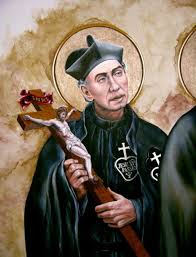
Report by Johnny McLaughlin:
Saint Charles of Mount Argus was born Joannes Andreas Houben on December 1, 1821, in the
village of Munstergeleen, Kingdom of the Netherlands.
He was one of eleven children of Peter Joseph Houben, a miller, and Johanna Elizabeth Luyten.
Young Joannes, or “Andrew” as he was called in the village, grew up poor and was considered quiet, shy, and a slow learner. Andrew enrolled in military service at the age of 19, in the First Infantry Regiment of the Netherlands. It became evident that he was not cut out for the army. The other soldiers would joke that “the miller’s son would not make a good soldier because he spent too much time in church.” When called out to deal with a disturbance in the village, he pointed his rifle the wrong way out of anxiety of hitting someone, and nearly shot his superior officer.
He was formally discharged in 1845 after only three months of active service.
Andrew was clearly discerning the religious life during his time in the military and became a
novitiate for the newly-established Passionist order the very same year he was discharged.
It was there that he was given the name “Charles of St Andrew.” The Passionists’ founder, St. Paul of the Cross, was determined to heal the infamous Christian divisions in Great Britain and return it to
the Church. St. John Henry Newman, our most recent Doctor of the Church, was converted by a
Passionist sent by St. Paul of the Cross.
Charles was sent to England first, but in 1857, he was transferred to the retreat of Mount Argus in
Harold’s Cross, Dublin, to be its new rector.
Charles initially struggled in his new role, as he had never fully mastered the English language and was infamously poor at preaching or giving sermons because of it. However, he excelled at hearing confessions, spiritual direction, and comforting the sick. His reputation for this, along with his piety, humility, and love for the Irish people, drew great crowds of people to Mount Argus to receive his blessings. His fame spread not just in Ireland, but in England, America, and Australia as well.
Charles was also famous for being a miraculous healer; in one instance, he healed a twelve-year-old boy of a lame leg. He became so famous for these miracles that diocesan authorities
and medical professionals actually conducted investigations of him. Charles briefly transferred
back to England because people started to take holy water blessed by him and sold it
throughout Ireland. He remained in England for seven years before returning to Dublin in 1874.
He remained there until he died in 1893.
People throughout Ireland attended his funeral. Witnessing the devotion of the people at the funeral, the Superior of Mount Argus wrote to his family, “The people have already
declared him a saint.” His fame and devotion in Dublin lasted well into the twentieth century, to
the point of being explicitly referenced in James Joyce’s Ulysses.
His cause for canonization was opened in 1935, and Pope St. John Paul II beatified him in 1988. The miracle of the healing of a man in his hometown of Munstergeleen paved the way to this canonization by Pope Benedict XVI in 2007. St. Charles is the patron saint of the sick, poor, suffering, immigrants, and broken-hearted. His feast day is January 5.
St. Charles of Mount Argus, pray for us!
References:
https://www.vatican.va/news_services/liturgy/saints/ns_lit_doc_20070603_carlo-andrea_en.html
https://web.archive.org/web/20111017065636/http://charlesofmountargus.org/index.htm
https://en.wikipedia.org/wiki/Charles_of_Mount_Argus